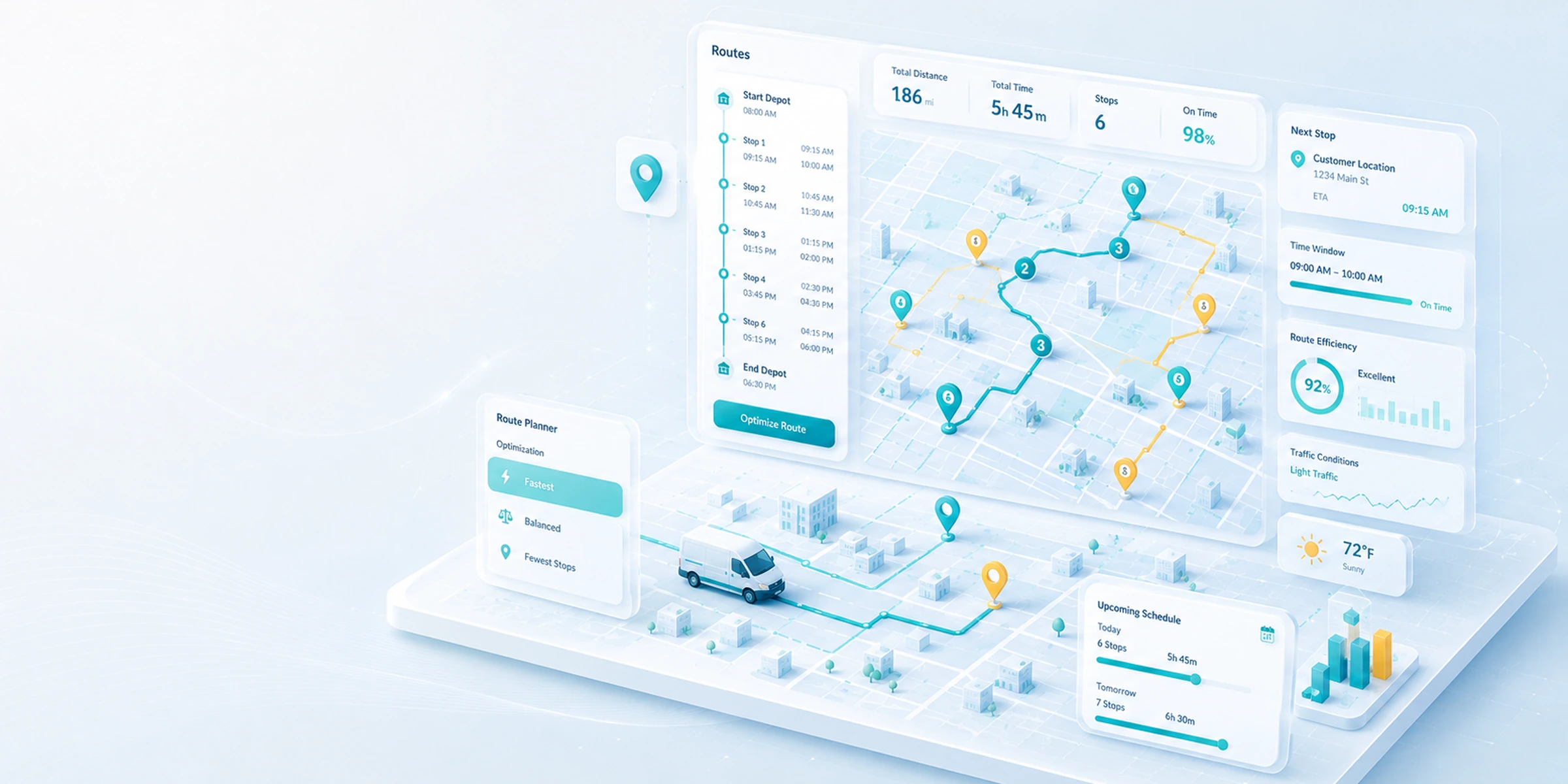
This collection helps you choose the right guide for reviewing an address, coverage rule, travel fee, missing route, or optimization proposal. These topics are related, but each step answers a different question and does not automatically guarantee the next. Available functions and information may vary by flow.
Go straight to the article that matches what is happening.
Choose the closest situation. MapMyStaff narrows the help center to the documented check that is most useful first.
No personal information is requested. Answers stay in this page and are not sent to the server.
Preparing the next question…
Loading the first question…
Understand five related topics without confusing them
An address may need to be checked and, when the flow allows it, converted into information usable for the next checks. A usable address or position does not prove on its own that an area is covered. A coverage rule does not automatically determine a travel fee. A route depends on the available information and conditions, while optimization compares or proposes an order without automatically constituting the final decision. Each guide addresses a particular step, and the operational decision may require confirmation suited to the context and available functions.
Reference points
Distinguish calculations from decisions
These five concepts are related, but they do not meet the same need and are not validated in the same way.
Address and resolution
Describes reviewing an address and, when the flow allows it, transforming it into information usable for the next checks.
Limit : A corrected or recognized address, or one associated with a position, proves neither area coverage nor complete accuracy of the information.
Territory and coverage
Describes checking the rules, areas, or coverage information available for the relevant flow.
Limit : Coverage should not be inferred from an isolated postal code, address, or map point.
Travel fee
Describes reviewing a possible business rule when a fee is displayed, expected, or disputed.
Limit : A fee should not be inferred from the displayed distance alone; its basis, threshold, and amount depend on the rule that actually applies.
Route
Describes a route calculated from the location information and other usable data available in the flow.
Limit : A displayed route guarantees neither future traffic conditions, an exact duration, nor a certain arrival time.
Optimization
Describes an order comparison or proposal based on the data and constraints considered.
Limit : A proposal guarantees neither the absolute best order, minimum distance, punctuality, nor a financial result.
Overview
From address to operational decision
The following flow helps place each guide. It does not replace the detailed checks specific to each situation.
01
Address reviewed
The input and visible information are reread.
Limit : An address may be incomplete, ambiguous, or not correspond exactly to the real situation.
02
Usable information obtained or issue documented
The available result is reviewed or the observed issue is documented.
Limit : This result does not prove that the area is covered.
03
Coverage reread
The available coverage rules and information are reviewed.
Limit : Their presence, form, and precision may vary by flow.
04
Possible fees checked
The visible or documented business rule is consulted when a fee is involved.
Limit : No universal amount, threshold, or calculation method should be inferred.
05
Route calculated or absence reviewed
The displayed result is reread or the absence of a route is documented.
Limit : A missing route does not automatically reveal its cause, and a displayed route does not guarantee future conditions.
06
Sequence compared and human decision
A proposal or comparison may be reviewed before applying an available change.
Limit : Optimization remains a decision aid and guarantees no perfect operational or financial result.
Guidance
Choose the guide based on the observed result
Start with the symptom or question that best matches what you see in your flow.
the visible rule, area, or category when one exists;
the fee or displayed message when one exists;
the exact observed result;
the action attempted;
the approximate date, time, and time zone;
a sanitized screenshot if useful.
Security instruction : Never send a password, authentication code, key, token, technical secret, unnecessary full address, or unnecessary personal information.